How can you tell if your dog has an ear infection?
Head shaking, scratching at the ear, redness inside the flap, a black, brown or yellow discharge and a strong yeasty or foul smell are the classic signs. Pain when you touch the ear, a head tilt, or a sudden dislike of being petted around the head are also common. Ear infections rarely clear up on their own, and colour alone cannot tell you whether it is yeast, bacteria or mites, so a vet needs to look down the canal and swab the discharge before treating.
An ear infection - otitis externa when it involves the outer ear canal - is one of the most common reasons dogs are taken to the vet. The good news is that it is also one of the easiest problems to catch early, because dogs almost always tell you something is wrong through their behaviour before you see anything inside the ear.
The most common signs of a dog ear infection
Most affected dogs show several of these together rather than just one:
- Head shaking - repeated, forceful shaking is usually the first thing owners notice.
- Scratching or pawing at the ear, or rubbing the side of the head along the carpet, furniture or your leg.
- Redness and swelling on the inside of the ear flap and around the opening of the canal.
- Discharge - commonly black, brown or yellowish, sometimes waxy and greasy, sometimes dry and crusty.
- A strong smell - a yeasty, musty or plainly foul odour coming from the ear.
- Pain or sensitivity - flinching, pulling away, whining or growling when you touch the ear or the area just below it.
- Heat - the ear flap feels noticeably warmer than the rest of the head.
- Scaly, crusty or thickened skin on the inside of the flap.
- Holding the head tilted to one side, or carrying one ear lower than usual.
- Behaviour changes - an affectionate dog suddenly ducking away from head strokes, becoming withdrawn or short-tempered, sleeping poorly, or eating less because chewing hurts.
The two-minute ear check you can do at home
- Choose a moment when your dog is calm and settled, not straight after a walk or a bath.
- Gently lift the ear flap and fold it back so you can see down into the opening of the canal. Do not push anything into the canal itself.
- Look at the colour. A healthy ear is pale pink, clean and dry, with only a trace of pale wax.
- Take a sniff from a few centimetres away. A healthy ear smells of very little. A sour, sweet or rotten smell is a red flag.
- Feel the base of the ear with your fingertips and watch your dog's face. Pulling away, freezing or a sharp lick of the lips all suggest it is sore.
- Compare left with right. One ear that looks or smells different from the other is a strong clue - and one-sided problems are more likely to involve a foreign body or a growth.
If the canal is so red, swollen or painful that your dog will not let you look, stop. Forcing it will hurt and will not change what happens next, which is a vet visit.
If the ears look healthy and you simply want to keep them that way, our guide to cleaning your dog's ears at home covers how often to do it and what to use.
What the discharge is telling you
The appearance of the debris gives a rough steer on the cause, but it is only a clue - not a diagnosis:
| What you see | Often suggests | Notes |
|---|---|---|
| Brown, waxy, greasy debris with a sweet or musty smell | Yeast (commonly Malassezia) | Frequently sits on top of an underlying allergy |
| Yellow, green or creamy pus with a foul smell | Bacterial infection | Often more painful; may need a culture if it keeps returning |
| Dark, dry, crumbly debris like coffee grounds | Ear mites | Most common in puppies and in dogs from multi-pet households; intensely itchy and contagious to other pets |
| Blood or blood-streaked discharge | Severe inflammation, self-trauma, a foreign body or a growth | Needs prompt veterinary assessment |
| Watery discharge with intense itching but little smell | Early allergic inflammation | May not yet be infected, but often becomes so |
Colour alone cannot separate yeast from bacteria from mites, and the treatments are different for each. This is exactly why vets take a swab and look at it under a microscope rather than guessing.
Early signs versus an infection that has been there a while
Early: occasional head shaking, a faint odour, mild pink discolouration, a bit more wax than usual, intermittent scratching.
Established or chronic: constant shaking and scratching, heavy discharge, a strong smell you can notice from across the room, a thickened or crusty ear flap, and a canal that has narrowed from long-standing inflammation. Chronic narrowing is significant - once the canal thickens and closes down, infections become much harder to clear and, in the worst cases, surgery is the only remaining option. Catching it early genuinely matters.
Warning signs the middle or inner ear is involved
If an infection moves deeper, the signs change from local irritation to balance and nerve problems. Treat any of these as urgent:
- A persistent head tilt, usually toward the affected side
- Loss of balance, stumbling, circling, or difficulty rising and walking
- Flicking or darting eye movements the dog cannot control
- Facial changes - a drooping lip or eyelid, or an inability to blink on one side
- Apparent deafness or not responding to familiar sounds
- Nausea or vomiting caused by the vertigo
These signs can also follow other conditions, but alongside a smelly or painful ear they point to otitis media or interna. Some nerve-related effects - head tilt, deafness, a drooping lip - can persist even after the infection itself is cleared, which is another reason not to wait.
Things that look like an ear infection but are not
- Ear mites - itchy with dark crumbly debris, and contagious to other pets in the house.
- A grass seed or foxtail in the canal - classically sudden, violent, one-sided head shaking in a dog that was completely fine an hour earlier.
- Allergies - environmental or food allergies are the underlying driver in a large share of cases; one veterinary source puts allergies at up to 43% of ear infections. If the ears keep flaring, the allergy is the real problem.
- An aural haematoma - a soft, fluid-filled swelling of the ear flap itself, usually caused by the head shaking rather than being the infection.
- A polyp or tumour - more likely in older dogs, typically one ear, sometimes with bloody discharge.
- A reaction to an ear product - some dogs react badly to a cleaner or drop, producing redness that mimics infection.
Which dogs get ear infections most
- Dogs with large, floppy or hairy ears - cocker spaniels, miniature poodles and Old English sheepdogs are classic examples, because reduced airflow keeps the canal warm and damp.
- Swimmers and dogs bathed often, where water sits in the canal.
- Allergic dogs, by a wide margin the biggest group.
- Dogs with hormonal conditions such as hypothyroidism, which is linked to recurring infections.
- Dogs in hot, humid climates.
- Dogs whose ears are over-cleaned, plucked or poked with cotton buds, all of which irritate the canal lining.
When to call the vet
Book an appointment if you see redness, discharge, odour, or head shaking that lasts more than a day, or if your dog seems sore around the head.
Go urgently if there is a head tilt, loss of balance, uncontrolled eye movements, facial droop, bleeding from the ear, sudden deafness, severe pain, or if your dog is crying out.
Why home treatment alone is a bad idea
It is tempting to reach for a leftover bottle of drops or a home remedy, but there are three real risks:
- You cannot identify the organism by eye. Yeast, bacteria and mites need different medications, and using the wrong one wastes time while the ear gets worse.
- You cannot see the eardrum. If it has ruptured, several common cleaners and medications can reach the middle ear and cause lasting damage to hearing and balance. Only an otoscope shows whether the eardrum is intact.
- Partial treatment breeds resistant infections. Stopping early, or treating repeatedly without addressing the underlying allergy, is how a simple infection becomes a chronic one.
What the vet will actually do
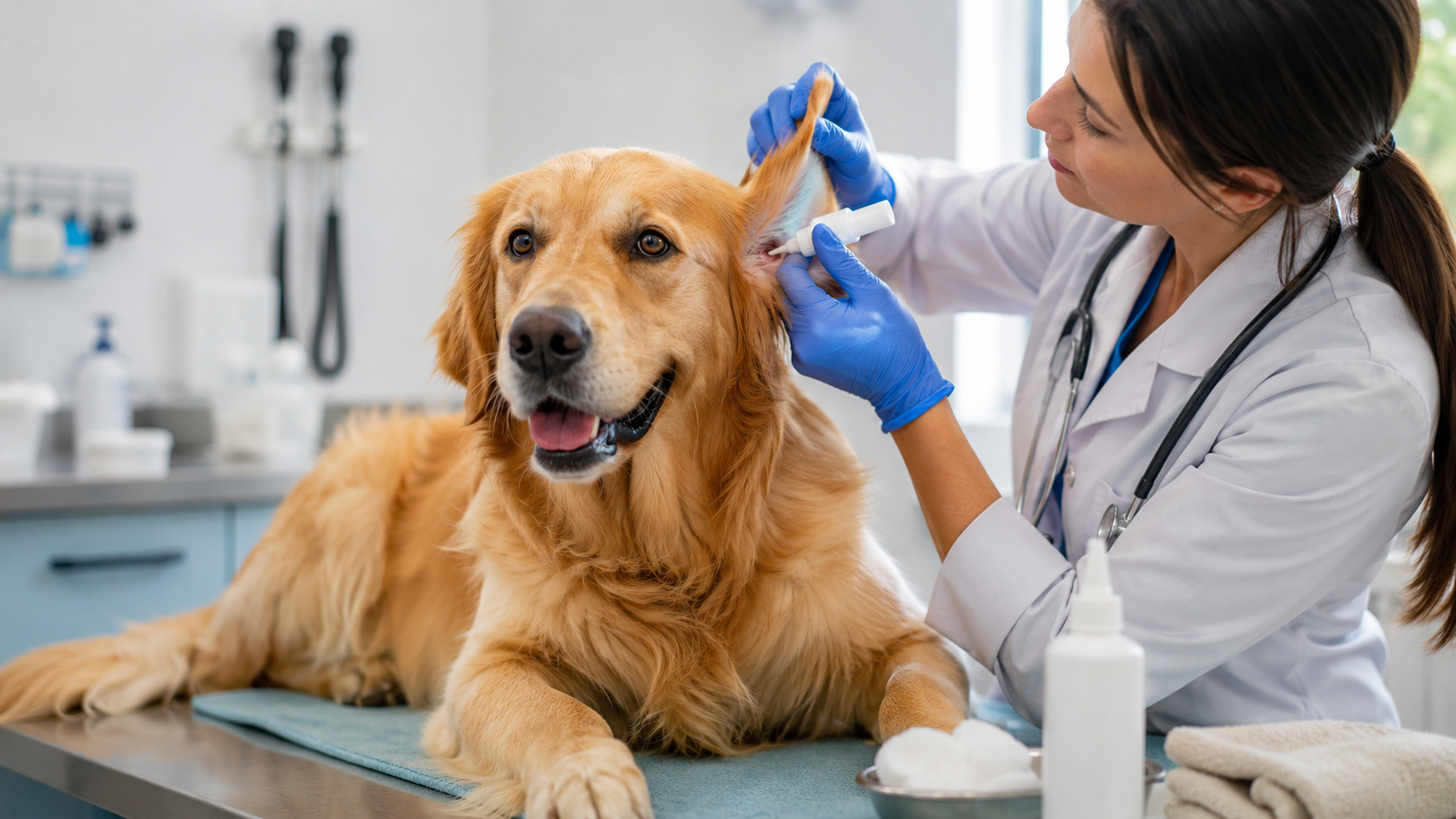
- Examine the canal with an otoscope to check for debris, foreign objects, parasites and the state of the eardrum.
- Take a swab of the discharge and look at it under the microscope to identify yeast, bacteria or mites, which determines the medication.
- Send a culture if the infection is resistant or keeps coming back.
- For chronic or strictly one-sided cases, investigate further - allergy testing, thyroid testing, imaging or a biopsy - because a recurring ear infection is a symptom, not the whole diagnosis.
Most straightforward outer-ear infections improve within a week or two of the correct treatment, but always finish the full course even if the ear looks normal sooner.
References
- Ear Infections and Otitis Externa in Dogs - MSD/Merck Veterinary Manual
- Ear Infections in Dogs (Otitis Externa) - VCA Animal Hospitals
- Otitis Media and Interna (Middle and Inner Ear Infections) in Dogs - MSD/Merck Veterinary Manual
This article is general information, not veterinary advice. If you think your dog has an ear infection, please have it examined by a qualified veterinary professional.