Home Remedies for Dog Vomiting: Causes, Safe Treatments & When to See a Vet
Disclosure: some links below are affiliate links. If you buy through one we may earn a commission at no extra cost to you. It never changes what we recommend or how we rank it.
Most dogs vomit from time to time and are completely fine. Some are not — and telling those two apart matters far more than any remedy on this page. So we are going to do this backwards: the warning signs come first, and the home care comes after.
If your dog is bright, alert, drinking, and has thrown up once or twice with nothing else going on, careful home care is reasonable. If any of the red flags below apply, stop reading and call a vet.
Call a vet now if you see any of these
These are not "wait and see" situations. Contact your vet or an emergency clinic immediately if your dog is:
- Retching or heaving without bringing anything up, especially with a swollen, tight belly, pacing or obvious distress. This can be gastric dilatation-volvulus — "bloat" — which is fatal within hours and most common in deep-chested breeds.
- Vomiting blood — either fresh red, or dark specks that look like coffee grounds.
- Suspected of eating something toxic or an object — socks, string, corn cobs, bones, toys, chocolate, xylitol, grapes or raisins, antifreeze, medication.
- Collapsing, weak, or breathing oddly, or has pale, white or blue-tinged gums.
- Vomiting repeatedly — several times in a few hours, or on and off for more than 24 hours.
- Painful — hunched, tense, praying-position stretching, or reacting when you touch the abdomen.
- Vomiting with profuse or bloody diarrhea, particularly an unvaccinated puppy. Parvovirus kills quickly and needs hospital treatment.
- Unable to keep even water down.
The same applies with a much lower threshold to puppies, senior dogs, toy breeds, pregnant dogs, diabetic dogs and any dog with an existing medical condition. They have far less reserve and dehydrate much faster than a healthy adult.
If you think your dog has eaten something poisonous, ring a poison control service straight away rather than waiting to see what happens. In the US, the ASPCA Animal Poison Control Center is on (888) 426-4435 and the Pet Poison Helpline is on (855) 764-7661. Both charge a consultation fee and both are available around the clock. Elsewhere, contact your vet or your national animal poison line.
First, is it actually vomiting?
Vomiting and regurgitation look similar in a panic and mean different things, so it is worth knowing which you saw.
| Vomiting | Regurgitation | |
|---|---|---|
| Effort | Active — retching, heaving, visible abdominal contractions | Passive — food simply falls out, often with no warning |
| Warning signs | Drooling, lip licking, restlessness, swallowing repeatedly | Usually none |
| Contents | Partly digested, often with yellow bile | Undigested food, sometimes tube-shaped, coated in mucus |
| Timing | Any time after eating | Usually soon after eating |
Regurgitation points towards the esophagus rather than the stomach, and repeated episodes need investigating rather than home management. If what you are describing is regurgitation, book an appointment instead of working through the remedies below.
Why dogs throw up
The common, usually mild causes:
- Dietary indiscretion — bin raiding, something dead on a walk, a rich table scrap. Comfortably the most common reason.
- Eating too fast, or exercising straight after a meal.
- A sudden change of food without a proper transition.
- Motion sickness in the car.
- An empty stomach — see bilious vomiting syndrome below.
The causes that need veterinary attention:
- Intestinal parasites, particularly in puppies.
- Infections — parvovirus, bacterial gastroenteritis and others.
- A foreign body obstructing the gut. Persistent vomiting with no other explanation is a classic sign.
- Pancreatitis, often after a fatty meal, with abdominal pain and lethargy.
- Toxins, including several everyday human foods.
- Chronic illness — kidney disease, liver disease, Addison's disease, inflammatory bowel disease, cancer.
- Medication side effects.
You cannot reliably tell these apart at home, which is the entire reason the timeframes further down this page are as short as they are.
What the vomit is telling you
Clear liquid
Usually water or saliva, and often a sign of nausea or of drinking a lot quickly. A single episode in an otherwise bright dog is rarely alarming. But be careful: a dog trying to vomit and producing only a little clear fluid or froth is also an early picture of bloat. If there is any heaving without result, or the belly looks distended, treat it as an emergency.
Yellow or green
That is bile, which means the stomach was empty. Common first thing in the morning or after a long gap between meals — see the bilious vomiting section below.
White foam
Often just saliva and gastric fluid on an empty stomach. Same caveat as clear liquid: repeated unproductive foaming with a tight abdomen is an emergency, not an upset tummy.
Undigested food
Soon after eating, this usually means eating too fast, too much, or excitement around mealtimes. Hours after eating, it suggests food is not leaving the stomach — that needs a vet.
Blood, or anything like coffee grounds
Fresh blood or dark granular material means bleeding somewhere in the upper gut. Always a same-day veterinary call.
Safe home care for a mild, one-off upset
Everything in this section assumes a healthy adult dog with none of the red flags above, who is bright, alert and behaving normally between episodes. If that is not your dog, skip to the vet.
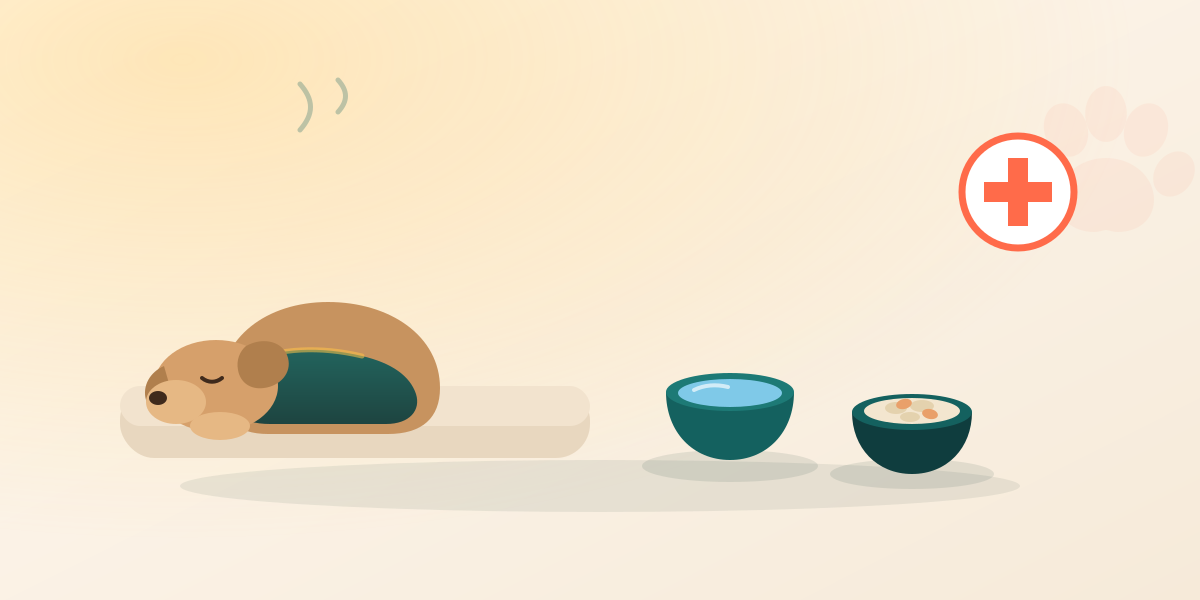
1. A short rest from food — but a short one
Giving an irritated stomach a few hours off can help. For a healthy adult dog, roughly 6 to 12 hours without food is generally enough. Long fasts are no longer routinely recommended: getting nutrition back in reasonably early tends to help the gut lining recover.
Do not withhold food at all from puppies under six months, toy and small breeds prone to low blood sugar, pregnant or nursing dogs, diabetic dogs, or any dog on medication that must be given with food. For these dogs, ring your vet instead.
2. Water in small amounts, often
A dog that gulps a full bowl after vomiting will usually bring it straight back up. Offer small amounts every twenty to thirty minutes, or a few ice chips to lick. If those stay down for a couple of hours, gradually increase the amount.
If your dog cannot keep any water down for more than a few hours, that is a vet call — dehydration is the thing that turns a minor upset into a serious problem.
3. Reintroduce food blandly
Once several hours have passed with no vomiting, offer a small amount of something easy to digest. The standard option is boiled skinless chicken breast with plain white rice, roughly one part chicken to two parts rice, with no salt, oil, butter, onion or garlic. Plain boiled potato or plain cooked pasta work too.
Start with a portion far smaller than a normal meal. If it stays down, offer another small portion a few hours later. Little and often beats one big bowl.
4. Return to normal food gradually
After a day or two of bland food with no further vomiting, mix increasing amounts of their usual food back in over two to three days. Jumping straight back to a full normal meal is a common way to restart the whole thing.
What about pumpkin, ginger or probiotics?
Plain canned pumpkin — the pure kind, never pie filling, which contains spices and sugar — is a reasonable source of gentle fiber and is more useful for loose stools than for vomiting itself. Probiotics formulated for dogs are widely used after a gut upset and are low-risk. Ginger is commonly suggested for nausea, but evidence in dogs is thin and dose matters, so ask your vet before using it rather than guessing.
None of these treat a cause. They support a dog whose problem was already going to resolve.
Home remedies for bilious vomiting syndrome in dogs
Some dogs reliably bring up yellow bile early in the morning, late at night, or any time the stomach has been empty for a long stretch. They are otherwise well, eat normally, and are perfectly happy afterwards. This pattern is often called bilious vomiting syndrome, and it is one of the few situations where a genuine home adjustment usually fixes the problem.
What tends to help:
- A small snack last thing at night, so the stomach is not empty through the small hours. This alone resolves many cases.
- Splitting the daily ration into three or four smaller meals rather than one or two large ones.
- Bringing breakfast earlier, or leaving a small portion for the early morning.
Two important caveats. First, the pattern has to actually fit — occasional yellow vomit alongside lethargy, weight loss, appetite changes or diarrhea is not bilious vomiting syndrome and needs investigating. Second, this is a description of a pattern, not a diagnosis. Your vet may want to rule out other causes, and in persistent cases may prescribe an acid reducer or a motility drug. Do not reach for human antacids on your own.
When vomiting and diarrhea happen together
Both at once raises the stakes, because fluid is leaving in two directions and dehydration arrives much faster. It also widens the list of possible causes to include infections, parasites, pancreatitis and toxins.
For a healthy adult dog with one or two mild episodes of each, who is otherwise bright, the same cautious approach applies — small amounts of water, a short food rest, bland food, close observation. Watch for dehydration: tacky or dry gums, sunken-looking eyes, lethargy, and skin over the shoulders that is slow to flatten when gently lifted. These are crude signs and a dog can be meaningfully dehydrated before they are obvious.
Go to a vet without waiting if there is blood in either the vomit or the stool, if your dog is a puppy or senior, if it continues beyond 24 hours, or if your dog becomes lethargic at any point. Vomiting plus bloody diarrhea in an unvaccinated puppy should be treated as a parvovirus emergency until a vet says otherwise.
What never to give a vomiting dog
Human medicine is the fastest way to turn a mild upset into an emergency. Never give any of the following without explicit veterinary direction:
- Ibuprofen, naproxen or aspirin — cause stomach ulceration and kidney damage in dogs, and are a common cause of serious poisoning.
- Paracetamol / acetaminophen — damages the liver and red blood cells.
- Bismuth subsalicylate products (Pepto-Bismol and similar) — contain an aspirin-related compound, and darken the stool in a way that can mask genuine intestinal bleeding.
- Loperamide (Imodium) — dangerous in herding breeds such as collies, Australian shepherds and shelties, which commonly carry a gene mutation affecting how the drug is cleared.
- Antacids and acid reducers intended for people — dosing is not a matter of scaling down, and they can mask a problem that needs diagnosing.
Do not try to make your dog vomit. Inducing vomiting with hydrogen peroxide at home is now widely discouraged by veterinary professionals: it can cause severe stomach inflammation and ulceration, and with some substances — anything caustic, or anything that could be inhaled — bringing it back up causes more damage than leaving it. If something has been swallowed, ring your vet or a poison line and follow their instructions.
Also avoid: milk and dairy, fatty leftovers, anything seasoned, bones, and any food containing onion, garlic, xylitol, grapes or raisins.
When to see a vet even without an obvious emergency
Book an appointment if:
- Vomiting continues beyond 24 hours, or returns each time you reintroduce food.
- Your dog has vomited more than two or three times in a day.
- They are off their food for more than about a day.
- Vomiting keeps recurring over weeks, even if each episode seems minor.
- There is weight loss, a duller coat, increased thirst, or any change in energy.
- Your dog is on long-term medication, or has a diagnosed condition.
- Something simply feels wrong. You know your dog; a vet would much rather see a healthy one than miss a sick one.
Reducing the odds of a repeat
- Change food gradually over seven to ten days rather than overnight.
- Use a slow-feeder bowl or a puzzle feeder for dogs that inhale their meals.
- Leave a gap between eating and vigorous exercise.
- Split the daily ration into smaller, more frequent meals for dogs with sensitive stomachs.
- Keep bins secured, and keep medication, chocolate, xylitol products, grapes and raisins well out of reach.
- Stay current with worming and vaccination.
- On walks, watch what goes in the mouth — a huge share of one-off vomiting starts with something scavenged outdoors.
The bottom line
For a healthy adult dog who has vomited once or twice and is otherwise themselves, a short rest from food, careful rehydration and a couple of days of bland meals is sensible, low-risk home care. That covers a good proportion of cases.
What home remedies cannot do is tell you whether the cause is a scavenged sandwich or an obstruction. That is why the timeframes here are deliberately short and the thresholds deliberately low. If your dog is deteriorating, in pain, bringing up blood, retching without producing anything, or you simply cannot settle the worry — stop managing it at home and ring your vet.
This article is general information about healthy adult dogs. It is not veterinary advice, and it cannot account for your dog. Anything involving symptoms, medication or a diagnosed condition belongs with a vet who has examined your animal. In an emergency, contact your vet or an emergency veterinary service immediately.